Sweet & Sassy Scribblers
​
  • Genres
  • Fiction
    • Books for Children
    • Fantasy
    • Thrillers
    • Mysteries
    • Women's Fiction
    • Science Fiction
  • Nonfiction
    • Well-being
    • Spiritual Psychology
    • Poems, Essays, Etc.
  • Heart Song Ghostwriting
  • MindSlap! - Spiritual Psychology
  • Let's Get Our Hands Dirty
  • The Scribblers

Setting the Scene for the LADYBUG

5/30/2023

0 Comments

 
Picture
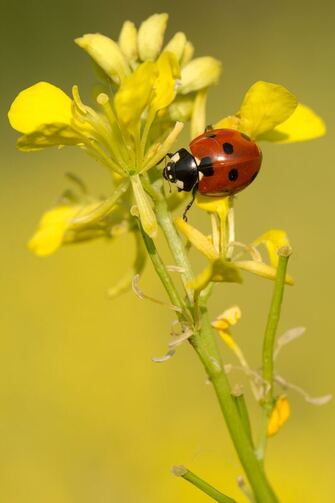
When someone says ladybug, most of us think of them as cute. In the insect world, however, ladybugs have a more serious calling.

First, however, consider this common question: Why are they called ladybugs? Well, they belong to the family Coccinellidae. Their name originated during the Middle Ages when farmers were battling insects destroying their crops. Being Catholic, the farmers prayed to the Virgin Mary for help. Not long after, the ladybugs arrived in time to chow down and save the crops. First, they were called The Beetles of Our Lady, but it was shortened to ladybugs.
​

Facts and Myths
Being the diva of the pollinators, many interesting myths exist regarding ladybugs. Still, the facts are quite interesting in themselves.

Did you know they can fly up to 37 miles per hour? Considering they beat their wings 85 times per second, it’s not surprising!

Four states in the United States chose this cute little pollinator as their state insect.

Their outer shell, the Elytra, is made of the same material, Chitin, as your fingernails.

The ladybug doesn’t see so well, so their antennae are very important. The antennae help them smell, taste, and feel their way around to find their dinner.

When ladybugs emerge from the pupa, they have no spots. It takes about half a day for the spots to appear. Some say that the number of spots tells its age. Not true. The spots indicate its species, not its age. However, the spots do fade as they get older. A ladybug is classified as a Senior Citizen anywhere from one to two years.

Those widely held yet false beliefs about ladybugs range from luck to love to sorrow. If you’re looking for a good luck omen, some say the ladybug is the answer. If a ladybug lands on you, according to myth, you get to make a wish. Now, here is where the number of spots is said to serve a different purpose. They reveal how many months or years it will be before your wish becomes a reality!

Remember the connection to the Virgin Mary? Well, ladybugs with seven spots, particularly dark ones, are said to represent the seven sorrows Mary went through.

Finally, seeing a ladybug in a moment of sorrow or struggle is supposed to mean that the one you’ve lost is looking out for you even after their death. 

The Ladybug’s Real Calling
Like most pollinators, ladybugs pick up pollen when encountering flowers and spread it to other flowers. They sometimes eat nectar but mainly seek insects because they are carnivores.
So, besides being pollinators, ladybug larvae and adults are excellent pest controllers. You should never try to eliminate them with pesticides. They eat almost 24/7. They consume insects such as aphids, mites, scale insects, and whiteflies that are harmful to crops and small gardens while leaving the plants unharmed.

One exception to the beneficial insect label is the Epilachninae, sometimes known as the Vegetarian. It is a subfamily of the Coccinellidae. Their biology is different from those ladybugs with which we are most familiar. Instead of being carnivores, they are mainly leaf-feeding herbivores, which means they can be classified as crop pests.

How Do Ladybugs Defend Themselves?
Predators are pretty much a constant in nature, and it’s no different for ladybugs. Birds, tree frogs, dragonflies, parasitic wasps, assassin bugs, robber flies, and Joro spiders are examples of those who eat ladybugs. Strangely enough, there’s even a fungus that attacks ladybugs. It is known as Hesperomyces virescens and is a parasite of the alien species, the Asian Lady Beetle, which is immune to the parasite. Hesperomyces-infected ladybugs suffer increased mortality rates.

Under most circumstances, their stinky chemical called pyrazine is their greatest defense against predators. Their brightly-colored bodies warn predators that it is poisonous, even though it’s not. Their third defense is playing dead until the danger passes.

Picture
​The Bad Guy!
The Asian Lady Beetle, sometimes known as the Asian harlequin ladybird is native to eastern Asia. It was introduced into Europe and North America by farmers to control aphids.

When you buy ladybugs from the garden supply store, you are usually getting the invasive lady beetle species. So please, do not purchase ladybugs. Instead, plant the flora that attracts the native variety.

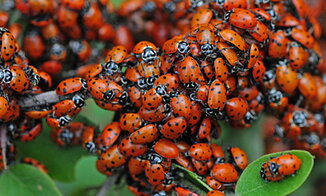
In many places in the United States, Asian lady beetles have destroyed the native ladybug by infesting them, outcompeting them for resources, and eating them.

Ladybugs and Asian lady beetles may look alike, but key differences can help tell them apart. Asian lady beetles are slightly larger than ladybugs. All ladybugs are bright red with black spots, while the color of Asian lady beetles varies from red to orange. Ladybugs have a round or oval shape. Asian lady beetles are usually a little longer, and the head or snout is more pointed.

The easiest way to tell them apart is the head. Ladybugs have mostly black heads with small white markings that sometimes resemble cheeks. These are found only on the sides of their heads. ‌Most Asian lady beetles have a small, dark marking shaped like an M or W on the whitish area behind the head. This marking varies in size and shape but is always present.

Although the two look similar, that’s where the similarities end. Ladybugs are highly beneficial, harmless, and do not bite nor congregate in large groups.

On the other hand, Asian lady beetles are considered a true pest. Unlike ladybugs, they will gather in large groups and leave a yellow, foul-smelling liquid on surfaces where they congregate. Ladybugs hibernate during the cold weather, whereas lady beetles are attracted to bright colors and like to overwinter in our nice warm homes. Once inside, they congregate in dark, secluded places for warmth, including attics, crawl spaces, closets, and storage areas. They particularly like hiding behind framing and siding.

Instead of crushing any beetles you find, vacuum them and dispose of the bag. Then, use soapy water to clean the surfaces where they congregate. ‌They aren’t dangerous but can be extremely messy.
 
Unfortunately, the bad guys are here to stay, but we can stop the importation of the alien species by not purchasing them and destroying any that we find.
​
Ladybugs are the good guys. So keep an eye out for these voracious predators and thank them for the great work they do by providing habitat and do not use pesticides!

0 Comments

Being a Good Steward

5/23/2023

0 Comments

 
Picture
Being a good steward of Planet Earth can be accomplished in many simple, easy, and painless ways. Caring about our environment is the primary focus. After that, how you proceed is up to your individual preferences.

Donna Merrill, the founder of Pollinator Pathways, suggests that the best thing you can do is to do nothing. "Stop worrying about having a manicured lawn. Stop using pesticides. Don't rake your leaves. If a tree falls and presents no danger, leave stacks of woods and brush for pollinators and animals to use as habitat."

In other words, relax and let nature take care of itself.

What if you're not interested in landscaping or gardening? You may not have a yard, or maybe you're not into digging in the dirt. Don't worry about it! You can support conservation and make a positive difference in your little part of the world by educating others about the importance of being good stewards.
 
Spreading the Word
Donna began her pollinator conservation campaign by walking door to door through suburban neighborhoods giving out free trees and explaining why it was imperative to help the bees, butterflies, and birds. Young and old alike bought into the ideas of incorporating more native plants into their landscape, removing invasive plants, and stopping the use of pesticides.

Word spread to neighboring communities, and Donna's simple act blossomed into a regional network of pathways for pollinators. From there, it continued to expand, eventually reaching other towns and other states. Today, the pollinator corridors stretch from the Canadian border south through nine states.

Follow Donna's lead. Education is the key that transforms an idea into reality — getting your neighbors to understand why they shouldn't rake the leaves or use Round-up™ on those dandelions open doors to teaching them about conservation. Your contagious enthusiasm will spark their interest in attracting buzzing bumblebees and fluttering butterflies to their property. They'll tell their friends, and the cycle continues. Next on your agenda could be organizing events and connecting with garden clubs, community colleges, schools, civic groups, and whoever else will listen. If you're serious about supporting conservation, there are countless activities you can participate in.

Talking with others is an effective way to spread the word without dirtying your hands. And it's as essential and effective as planting native flowers, trees, and shrubs.

Everyday Conservation
Another path open for you is being an example to all your friends and family. Show them how serious you are by taking steps at home that make a difference. Remember, conservation is more than planting flowers. So many issues need to be addressed, such as  air, water, and land pollution, global warming, reducing your carbon footprint, plastic pollution, as well as the overuse of pesticides, and the destruction of native habitats and ecosystems.

Be a role model:
  • Stop buying single-use plastics – Over 10 million tons of plastic enter the oceans annually, and many more tons are dumped in landfills. Water and soda bottles are significant sources of contamination. Other types of plastic packaging also compound the problem. Everything you purchase, from toys to laundry detergent to food, seems to be wrapped in plastic. Solution: It may cost a little more, but try to find items with as little plastic packaging as possible. As an alternative to water bottles, get a reusable water bottle and refill it from the tap. If you want purified water, get a pitcher with a filter and keep some refreshing cold water in the fridge. When you stop buying all those bottles, not only do you help the environment, you save money too.
  • Use glass storage containers instead of plastic – I love salads but hate the soggy, brown lettuce and limp green onion from storing my veggies in plastic bags in the fridge. Solution:  I make several days' worth of salads by chopping up and layering my veggies in pint-size canning jars. Even after a week, my salad is still crisp and delicious. I use quart-size canning jars to store the leftover salad fixings. The lettuce, mushrooms, and other goodies keep fresh in the sealed bottles for 3-4 weeks. Can't say that for plastic bags!
  • Avoid using plastic/styrofoam utensils and plates – It's so convenient to use those disposable plates and spoons when you're out on a picnic or hosting a BBQ. However, please look for alternatives. Even though they're more expensive, biodegradable disposables could be an option. Old-fashioned paper plates are a pain but are better than clogging up our landfills with plastic garbage that lasts forever. For your picnics, pick up an old-fashioned picnic hamper on Ebay or Etsy. Sure, the hamper has plastic plates and utensils, but they're washable and can be used again and again.
  • Do you know your Carbon Footprint? Many of our daily activities - such as using electricity, driving a car, or disposing of waste - cause greenhouse gas emissions. Together these emissions make up a household's carbon footprint. Calculate your family's carbon footprint using the tool provided by the Nature Conservancy.
  • Use reusable shopping bags.
  • Give up gum. Gum is made of synthetic rubber, aka plastic.
  • Purchase cereal, pasta, and rice in bulk and fill a reusable container. You'll save money and unnecessary packaging.
  • Avoid buying frozen foods. Their packaging is primarily plastic. Plus, it's healthier; you'll be eating fewer processed foods!
  • The EPA estimates that 7.6 billion pounds of disposable diapers are discarded in the US each year. Use cloth diapers to reduce your baby's carbon footprint and save money.
  • Reduce, Reuse, Recycle
If you're serious about supporting conservation, there are countless ways to spread the word, and everything you do will be greatly appreciated.

​Now, it's your move.

0 Comments

Mother Nature Won’t Give Up Without a Fight

5/16/2023

0 Comments

 
Picture
The woods have always been my favorite place to escape it all. It’s so peaceful. Watching a woodland creature wandering through the understory or catching a glimpse of a mama bird tending to her chicks makes the experience all the better. Sitting on my pillow of leaves and pine straw, I close my eyes and tune in to nature’s sounds and smells. I love it.

Well, at least I used to love it, but there are too many distractions now. I can’t follow a deer trail cutting through the brush without my adventure being sabotaged by the “signs” of someone being there before me.

We can find two types of litter on the forest floor.

The first is the good stuff, what Mother Nature intended to carpet her landscape – leaves, plants, and other organic materials that decompose and nourish the earth.

The second is the not-so-good stuff – plastics, metals, and other inorganic materials that pollute the land and poison the soil and water. Think of the innocent creatures in our woodlands, the victims of our careless actions. They could be injured or possibly unable to find food because humans throw rubbish everywhere without considering the consequences of their actions.

How about the bugs? Does litter cause any problems for the insects crawling or buzzing around?

Yep, it sure does. And we must be concerned because those little beasties touch our lives in more ways than you realize.

Not all bugs are pests. Actually, the majority of them are vital for our existence. Pollinators such as butterflies, bees, beetles, birds, bats, and countless other winged and six-legged creatures pollinate seventy-five percent of the world’s food, beverage, and fiber crops. That equates to one in every three bites of food we eat being provided by pollinators. They are critical to our food supply.

 Woodlands and meadows provide homes and food sources for the pollinators, and in return, the pollinators do what they do best to ensure their habitat remains viable. Mother Nature created a wonderful balance so that everything benefits from one another. She’s tough too and can bounce back from disasters like fires, floods, and hurricanes. It may take a while, but she won’t give up without a fight. 

Yet, she has her limits. Nature may be resilient but can’t fight foreign objects obstructing plants from growing. Similarly, she can’t prevent the liquids and chemicals from seeping into the soil and water, poisoning the habitat and its inhabitants.

The balance has been disrupted. There’s no longer a healthy, diverse selection of native plants inviting the birds and the bees to visit the flowers and the trees. Without pollination, the ecosystem withers away. Likewise, without the proper habitat to house and nourish them, the pollinators disappear as well.

Of course, it’s not only litter causing the problem. Other factors are responsible for the decline in pollinator populations too. Overuse of pesticides and urban growth play a significant role, but the sad fact remains that more than forty percent of the world’s pollinating insects live under the threat of extinction.
​
Can anything be done? Most definitely!
  • When you see litter, pick it up and dispose of it properly.
  • If you see someone else littering, ask them nicely to pick it up and explain why. If they refuse to cooperate, be the bigger person and pick it up yourself.
  • There are many conservation groups working to restore pollinator habitats. Volunteer your services and learn what you can do to help.
  • Pollinator gardens come in every shape and size and can be planted anywhere, even in window boxes and patio containers. Add some native flora to your home’s landscape. Check with your local Native Plant Society, WildOnes chapter, or other native plant experts for the best flowers, trees, and shrubs for your area. 
Please, do what you can to make our world a better place for all living things. It takes minimal effort but makes a world of difference!

Picture
0 Comments

Alternatives to Using Herbicides

5/9/2023

0 Comments

 
Picture
​​Television commercials make it look so simple to safely get rid of all those unwanted weeds without affecting nearby grass and flowers, but in reality, it’s not quite so straightforward. Glyphosate, the active ingredient in Roundup® and other herbicide brands, is not as safe as the manufacturer wants us to believe.

Glyphosate is used extensively in agriculture, along highways, in commercial nurseries, and by homeowners. Each year more than 250 million pounds of this readily available weed killer is used in America, and studies have indicated that exposure to glyphosate causes cancer. It has also been shown to destroy beneficial bacteria in our bodies, disrupting the natural balance of good vs. bad bacteria and can lead to diseases such as diabetes, allergies, obesity, and heart disease.

Environmentally, it degrades the soil, contaminates water sources, destroys habitats, and reduces the availability of nectar sources for pollinators. It is also thought to interfere with honey bee navigation and messes with microbes in their gut, making the bees more susceptible to dangerous pathogens.

So Why Is Glyphosate Considered to Be Safe?Glyphosate testing conducted by manufacturers is done in a laboratory-controlled environment without using any of the other ingredients found in their over-the-counter products. However, scientists have found that the “inactive ingredients” combined with glyphosate in commercially-made weed killers amplify the toxic effects.

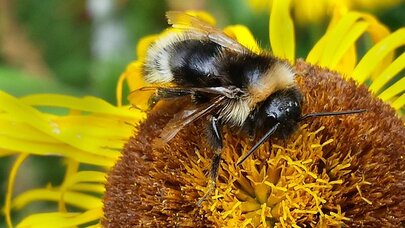
A study published in the Journal of Applied Ecology by researchers at the Royal Holloway University of London found that several Roundup® formulations with varying percentages of glyphosate are toxic to bumblebees. Even one containing no glyphosate proved lethal, indicating that the unnamed other ingredients that the manufacturers are not required to disclose are the ones killing the bumblebees.

There are many glyphosate products on the market with no information on the additional ingredients. So, consumers can’t know which ones contain a toxic cocktail harmful to pollinators (and humans).

Are there any alternatives to the dangerous chemicals? Yes! Safer options do exist. They are not as quick and easy as chemical pesticides but are much safer for you and the environment.
  
Alternatives to Chemical Herbicides
Pull Weeds Up by hand, hoe, shovel, or other tools. It works for small areas. Try to get the offensive plant up by the roots. Early spring is the best time to get the young weeds uprooted.

Disturb the Soil as Little as Possible to prevent bringing buried weed seeds to the surface. Refrain from tilling or digging any deeper than needed to plant seeds.

Don’t Give Weeds Room to Grow Dense ground cover will not allow any unwanted visitors to peek up through your flowers.

Mulching with a layer of organic material (compost, bark, wood chips, grass clippings, leaves, straw, etc.) will smother and prevent weeds from growing. A layer of mulch will also help retain water in the soil. 

You can cover your garden plot with cardboard, or newspaper for a few months to destroy grass and weeds ahead of planting time. You could also leave the biodegradable cardboard layer and cover it with woodchips or other organic materials such as soil or leaves.

Solarizing or covering the ground with a heavy plastic sheet works for baking the weeds until they are brown and very dead. It takes about 4-6 weeks in full sun. This works great to prepare larger areas for planting a garden or reseeding.

Boiling Water will get those hard-to-pull weeds creeping up between the paving stones in walkways or patios, as well as cracks in pavement or cement. I’ve never tried this method, but it couldn’t hurt to try.
​
One more thing you need to be aware of and can play a role in reducing – herbicide drift.

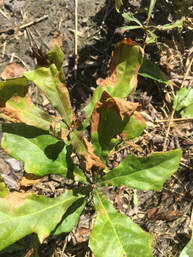
PictureA water oak sapling hit with the overspray from a nearby field.
Herbicide Drift
Even though residential use of herbicides is extremely high, with glyphosate being the number one product of choice, we have to be concerned about other poisons that are widely used. Homeowners generally apply weed killers directly to the area they want to concentrate on. On the other hand, agricultural operations spray large areas before crops are sown and also during the growing season. The chemicals applied by tractors spread out as the mist envelopes the fields. 

Herbicides such as glyphosate, dicamba, and 2, 4-D (used in Agent Orange in Vietnam) drift to nearby woodlands, residential areas, and water sources, contaminating them with toxic substances. They pose significant threats to wild plants degrading food sources for wildlife and pollinators. Oh yeah, they affect cultivated lands and humans too. Unfortunately, most of the damage goes unreported resulting in more and more commercial applications of these hazardous concoctions to farmer’s fields.

How do we fix this herbicide drift? Monitor and report the damage. Take photos and document the date of observation, location, the species affected, and, if possible, the source. Report your findings to the Ecological Pesticide Incident Reporting portal. They will forward the information directly to EPA, and your state pesticide regulatory agency.

It can take a few days to several weeks for plants to show any injury. Species vulnerable to the overspray include the American sycamore, Eastern redbud, dogwoods, elms, ash, box elder, and fruit trees like peaches and apples. Sensitive crops such as legumes, tomatoes, peppers, grapes, sweet potatoes, and melons are at grave risk. And don’t forget the wildlife and insects who depend on these as well as many other native plants for food and shelter.
​
Now is the time to stop the use of residential and commercial herbicides!
​

0 Comments

How Plants Communicate with Pollinators

5/2/2023

0 Comments

 
Picture
We’ve all become aware that 75-90% of flowering plants require pollinators to reproduce. So, the easiest way for the flowers to beat out the competition is to figure out ways to attract the pollinators. The process through which the plants evolve this skill is called pollinator syndrome. There's nothing Mother Nature cannot do!


​There are several ways the plants approach attracting pollinators: visual cues, fragrance, ultraviolet hints, and nectar tweaking.
 
Visual Cues
There are many visual cues flowers present which attract pollinators, cues they can spot from the air. These are shape, size, showy petals and sepals, and color.
Shape is an important visual cue because it enhances their access to the nectar. For example, irises produce large flowers to attract bumblebees; the bell-shaped flower of the azalea attracts hummingbirds; open, flat flowers like the purple coneflower are more pleasing to beetle and other non-flying pollinators.
 
Fragrance
Fragrance is connected to color in the pollinator syndrome. Connecting visual and olfactory channels, the signal the flowers send is stronger. If the fragrance is dissipated by wind, the color is still in effect. The connection between these two elements was determined by an international research team that reported its finding in Nature Ecology & Evolution.
 
Ultraviolet Hints
It seems that certain plants are capable of an optical effect that attracts bees, which are able to see what has been termed the “blue halo.” Certain species of flowering plants have tiny ridges on their petals. These ridges, which vary in height and spacing, scatter light to cast this bluish color, which is not visible by humans. A study by Cambridge University in 2017 suggests that these ridges evolved independently, possibly as a way to attract pollinators by tapping into the ability of bees to see blue and UV light.

Insects can see ultraviolet light, although some colors are not apparent to certain insects. Ants, for example, cannot see red. Because of this ability, flowers appear differently to insects in their structure and color, such as the black-eyed Susan. Yellow or violet flowers show a greater tendency to reflect ultraviolet light than do flowers of other visible colors. Many flowers which appear to have uniform structure in the visual spectrum reveal a more complex structure under ultraviolet light.
 
Nectar Tweaking
Nectar is primarily sugar water and is sort of a quid pro quo between the flower and the pollinator. Research has shown that the makeup of nectar varies among flowers. Butterflies are attracted to plants whose nectar is high in amino acids since butterflies lack protein in their diet. Hummingbirds prefer highly-concentrated nectar because of their energy needs. Bees, it was determined, are capable of discerning differences in sugar concentration as small as 1%-3%.

Plants are clever, however. Apparently they seem to know not to produce too much nectar or the pollinators will be sated quickly, which interferes with the pollination process.

On a side note, did you know that some flowers produce two kinds of pollen? One is the pollen involved in pollination; the other is a sterile pollen that serves as a protein food source for pollinators — yet another attracting element.
 
SYMBIOTIC ATTRACTION

Symbiotic relationships are when two participants mutually benefit from the relationship. Of course, pollination in general is symbiotic or mutualistic. Sometimes, however, it goes beyond simple pollination.

The Monarch butterfly is the pollinator for the milkweed plant. Beyond the nectar, the butterfly needs the milkweed to host its eggs and larvae. The caterpillars rely solely on milkweed for nourishment. This is not the end of the benefits Monarchs derive from the milkweed.

The sap that leaks out from the stem or leaves of the milkweed contains toxins. However, the Monarch is immune to its effects. Instead, the toxin serves to ward off predators, especially on the Monarch’s long migration, by making it deadly to vertebrates. The most common vertebrate predators of the Monarch butterfly are lizards, frogs, and birds. Feeding on a Monarch will make them sick and vomit, which tends to avoid viewing Monarchs as a food source.
 
HOW PLANTS KNOW TO PREPARE FOR POLLINATORS

Sound

A researcher reasoned that since plants and pollinators have obviously co-evolved over time, it would not be reasonable to believe that sound would be ignored as part of the plants’ pollinator syndrome arsenal. Considering the level at which sound saturates our planet, Prof. Lilach Hadany, Tel Aviv University, set out to prove that plants can differentiate between sounds. Once exposing the flower to various sounds, she discovered that the ultra-low frequency and the bee wingbeats caused the plant to spend the next three minutes increasing the sugar content in its nectar by 17-20%!

A benefit of this reaction to the sound of wingbeats, the plant was nine times more likely to be visited by a second pollinator within six minutes, a definite bonus for reproduction.

A new field of study, phytoacoustics, has been opened up by this study and one other, which played the sound of caterpillars munching on leaves next to an Arabidopsis plant. They discovered that in response to the sound, the plant flooded its leaves with a chemical deterrent.   
 
PLANT NEUROBIOLOGY

Through some means which scientists are researching, plants are able to retain information and make decisions about their survival based on past experiences. They are able to respond to threats such as when the leaves of a plant are being invaded by unwelcome insects and the plant releases airborne biochemical substances to other parts of the same plant as a defense mechanism.

Are they truly conscious? Not perhaps in terms of consciousness as defined for humans, which involves self-awareness. Heidi Appel, professor at the University of Toledo takes this stance: “Some have suggested that since plants can form ‘memories’ they are therefore conscious beings. Plants do retain information about what they experience, in that their response to changes in their environment can depend on what they’ve experienced previously. Even offspring may exhibit some traits that are influenced by what their parents experienced.

“Retaining information within and between generations of organisms is a trait of all living things, with an increasingly well-understood genetic basis. Whether these constitute ‘memories’ depends on whether you define ‘memory’ as ‘recall’ or something more. If we return to common definitions in the English language, memory as commonly defined does not require self-awareness.”

Regardless, if we are going to save our pollinators and our planet, we need to have a better understanding of their world, and perhaps the new fields of neurobiology and phytoacoustics can help.

0 Comments

    Greta Burroughs

    I am passionate about cleaning up our environment and restoring the habitats/ecosystems necessary for pollinators and wildlife to flourish.
    ​
    Yet, Pollinator Conservation and Environmental Restoration involve more than just planting trees, flowers, and shrubs. In order to regain the balance Mother Nature intended, we need to also counter pollution, global warming, overuse of pesticides, and destruction of ecosystems.

    ​By publishing articles, essays, and resources on this blog, I hope to Educate, Encourage, and Empower others to find a niche where they can make a difference in this world.

    Archives

    April 2024
    March 2024
    February 2024
    January 2024
    December 2023
    November 2023
    October 2023
    September 2023
    August 2023
    July 2023
    June 2023
    May 2023
    April 2023
    March 2023
    February 2023
    January 2023

    RSS Feed

    Picture
    Picture
I will read forever because it lets me visit in my mind the worlds that I will never be able to see; it helps me put away the stresses of the day and relax into the rhythm of the story before me; it lets me bring to the surface and experience without regrets those feelings I hide away; it lets me re-experience the thrill of first love through someone else's eyes; it keeps my mind juiced so that it will never desert me; it is always there for me even when there's no one else. I will read forever no matter whether it is print or digital because the words will always call to me. ~ A Sassy Scribbler