Sweet & Sassy Scribblers
​
  • Genres
  • Fiction
    • Books for Children
    • Fantasy
    • Thrillers
    • Mysteries
    • Women's Fiction
    • Science Fiction
  • Nonfiction
    • Well-being
    • Spiritual Psychology
    • Poems, Essays, Etc.
  • Heart Song Ghostwriting
  • MindSlap! - Spiritual Psychology
  • Let's Get Our Hands Dirty
  • The Scribblers

Sparking Kid’s Imagination

4/3/2024

0 Comments

 
Think back to your childhood. Do you remember listening to an adult reading Mother Goose nursery rhymes to you? I loved hearing them and was eventually able to recite the short poems about Humpty Dumpty, Jack and Jill, Jack be Nimble, and Hey, Diddle Diddle to whoever would listen.  

Mother Goose was a very good friend of mine. In my imagination, she was real, and I talked to her picture on the cover as I “read” my book. She looked so sweet and was always happy and smiling. Her patience while I created my own versions of her tales is probably why I became and still remain a book lover.

In the sixty-plus years since then, I’ve learned and forgotten many things, but not those beloved rhymes. When I became a preschool and elementary school teacher, Mother Goose entertained those kids during storytime just as she had done for me. I hope my students carried on the ritual with their own kids.

Traditional books, stories, and poems such as Mother Goose may lose some of their popularity with the more modern approach to children’s literature, but they’ll never die out completely. 
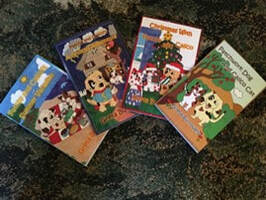
With my Patchwork Dog and Calico Cat series, I aim to continue the conventional themes of teaching kids about caring and sharing while entertaining them with humorous and delightful tales.

I want Patchy and Calico to spark their imagination so the early readers can visualize the mischievous dog as he embarks on yet another one of his exciting (mis)adventures, with Calico tagging along to bail her friend out of trouble. Children enjoy the hijinks as their young minds picture the dog and cat performing in a circus, running away from a scary ghost, or tracking down the mysterious gift snatcher.

I want the kids to laugh when Calico tricks her not-so-smart friend into thinking he can fly and then be proud of the silly dog when he finally does zoom through the air.
Along with entertaining their audience with their crazy antics, I hope Patchy and Calico demonstrate how being kind to others and giving presents to your friends can be so much more gratifying than receiving them. 

Will my children’s stories become known worldwide and treasured by generations of children? Short answer – NO.

But I can dream, can’t I?
​
Did you become an avid reader as a child? If you have children, do you read to them? If your children are older now, do they still love to read?

Picture
0 Comments

Captivate Readers with Your Blurb

3/27/2024

0 Comments

 
How do readers choose their next book? What can authors do to increase their chances of winning the ‘buy my book’ lottery?
The days of spending hours roaming the aisles of a book shop or a library gazing at hundreds of covers, handling each book, thumbing through its pages, catching a paragraph here or there until they eventually get around to reading the synopsis printed on the jacket cover are a thing of the past.

With online shopping, the hours-long leisurely stroll down the aisle has become more of a quick glance at an endless list of titles displayed on a computer screen. When a cover catches the reader’s eye, she skims the first few sentences of the book description or blurb. If it doesn’t entice her to read the rest, she goes on to the next book.

So, how do you lure a potential reader to choose your book over the other 999 titles listed in your genre?
Of course, the book cover makes the first impression, but it’s up to your blurb to convince the reader to hit the ‘buy now’ button before her attention is drawn away to another title.

How Do You Hook a Reader in 150 to 200 words?There’s a fine art to writing a book blurb that’ll captivate people’s interest making them want to learn more.  The customer already knows what kind of book she’s looking for. She’s narrowed down her search to a list containing the final contenders. It’s up to your blurb to convince her that your book is THE ONE she wants.

That’s easy to say, but not so easy to do. How do you condense a 60,000-word novel down to 150 to 200 words? First thing, you need to know and understand your genre. What’s the best-selling topic or theme? You also need to know your readers. What grabs their attention?

The best way to learn these things is by looking at blurbs written by successful authors in your niche. Content and style may vary depending on the type of book, but most fiction writers follow these guidelines:
  • Introduce the main characters
  • Highlight the adventure/conflict/action that drives the story
  • Mention any major obstacle
  • Build drama by hinting at what’s at stake

​Excellent Example in Fiction
Here’s the blurb from Tom Clancy’s novel, “Line of Sight.”

Twenty-six years ago, Dr. Cathy Ryan restored the eyesight of a young Bosnian girl who had been injured during an attack in the Bosnian War. Today, her son Jack Ryan, Jr. has agreed to track down the young woman and deliver a letter from his mother. What he finds shocks them both.

Clancy is a master at writing blurbs, covering all four points mentioned in only fifty-two words.

Excellent Example in NonfictionNonfiction is a little different, but the idea remains the same —  hook the reader in 200-300 words. Ideally, the first sentence surprises, shocks, intrigues, or stirs up the reader’s curiosity. It can also be an open-ended question.

The rest of the blurb should answer these questions:
  • What is the subject or the problem your book is going to solve, and how do you intend to do that? Will it be topic based or story based?
  • What is the scope of the book? Biography, self-help, memoir, etc.
  • What is the mood of the book? Humorous, cautionary, speculative.
  • For whom is it written? Expert or lay-person?
  • Does it entice the reader with a solution to a problem or an emotional payoff?
  • What are your credentials qualifying you to write the book?

Annie Gracie’s 228-word blurb for “This Naked Mind” is a good example.

This Naked Mind has ignited a movement across the country, helping thousands of people forever change their relationship with alcohol.
Many people question whether drinking has become too big a part of their lives and worry that it may even be affecting their health. But they resist change because they fear losing the pleasure and stress relief associated with alcohol and assume giving it up will involve deprivation and misery.
This Naked Mind offers a new, positive solution. Here, Annie Grace clearly presents the psychological and neurological components of alcohol use based on the latest science and reveals the cultural, social, and industry factors that support alcohol dependence in all of us. Packed with surprising insight into the reasons we drink, this book will open your eyes to the startling role of alcohol in our culture and how the stigma of alcoholism and recovery keeps people from getting the help they need. With Annie’s own extraordinary and candid personal story at its heart, this book is a must-listen for anyone who drinks.
This Naked Mind will give you freedom from alcohol. It removes the psychological dependence so that you will not crave alcohol, allowing you to easily drink less (or stop drinking). With clarity, humor, and a unique blend of science and storytelling, This Naked Mind will open the door to the life you have been waiting for.

Tips To Remember1. Either with fiction or non-fiction, give readers what they want without clichés or cheesy language, and never talk down to anyone.
2. Use keywords wisely. Keep from stuffing your blurb with unnecessary verbiage. Make every word count, especially the first sentence. Start with a hook and entice the readers to want more. Appeal to their emotions.
3. Remember, it’s not a book summary. You only have a limited amount of time to highlight the reasons why your readers should be reading your book. Think of it as a challenge. Go out there and win.

Picture
0 Comments

Unraveling Memories

3/20/2024

0 Comments

 
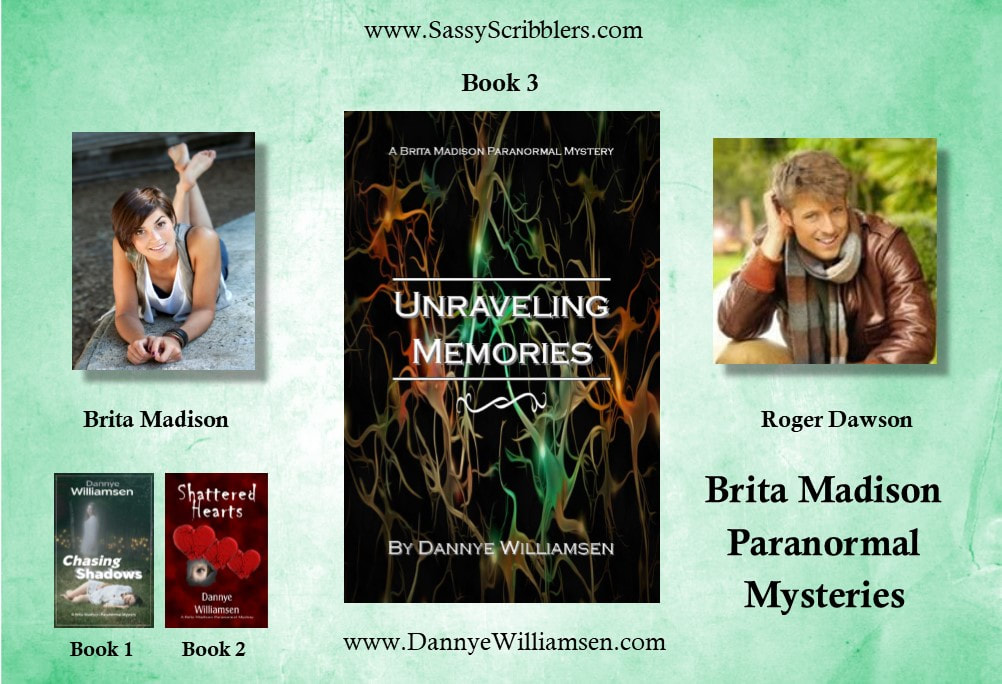
Brita Madison has come a long way since she first met James Weston five years ago. After nearly being killed twice and losing her best friend James at the hand of an evil pedophile, she appreciates the slower pace of her interactions with the spirit world since moving to Phoenix with her new husband, Sam Jenkins. All that comes crashing down when the past returns with a vengeance, threatening her family and friends.

As if to make up for lost time, spirits begin showing up whose muddled memories test the resolve of Brita and her friends, old and new, to meet the challenges from the past and the present.

“The common thread  across all of Ms. Williamsen’s novels (and I’ve read them all)  is the genuineness of her characters. I always turn the last page unwilling to let them go.” ~ Sharon Giarratana, long-time fan

If you've been following the series, you will see that life has definitely taken a different turn for your favorite characters! If you haven't, check out the links below. 

 
Unraveling Memories – Book 3 of the Brita Madison Paranormal Mysteries series
Kindle:  https://www.amazon.com/Unraveling-Memories-Madison-Paranormal-Mysteries-ebook/dp/B07T91CWHC
Paperback: https://www.amazon.com/Unraveling-Memories-Madison-Paranormal-Mysteries/dp/1075965926
Universal Link: http://viewbook.at/UnravelingMemories
Picture
0 Comments

Writing and Marketing

3/13/2024

0 Comments

 
Picture
I am always fascinated to see writers in the social networking groups spell out their frustrations and then watch the responses. This is when you really get to see the personalities show themselves. Many attitudes emerge, ranging from confident to know-it-all to self-assured to insecure to angry to helpful to loving—just to name a few.

The interesting thing to me is that the quality of the writing produced by the authors often has little to do with the attitudes they convey. Some brash know-it-alls produce poor quality work; whereas, some insecure personalities write beautifully. I learned early on that I couldn’t assume how good someone’s book would be by how confident they were about it and themselves and how good they were at marketing.


Picture
Marketing is a skill that was not necessarily packaged with the skill of writing when you picked up your talents on your way into this life experience. In turn, writing skill was not necessarily packaged with the ability to market products. Bottom line is this: just because a writer is a good marketer does not necessarily mean he or she is a good writer.

If you’re a fellow writer, take the time to read your colleague’s book before marketing it yourself, or at the very least, follow the advice given below for a regular reader.

If you’re a reader, you should never choose a book based on the author’s marketing. If you’re buying books through Amazon, “look inside.” If you’re at the bookstore, read the first chapter. If a friend has read it, question them about it.

Take time to read books that aren’t in your face all the time. I have been reading books lately by authors I’ve never heard about before, and I have discovered, to my delight, that there are so many excellent indie writers out there whose books I’ve never seen on Facebook.

I admit that I am not a good marketer of my own “stuff” so it warms my heart when I can share above average books I’ve read that aren’t big sellers with others. If everyone made the effort to expose little-known writers who write well,  it could make a big difference for a lot of writers and the industry as a whole.


0 Comments

Glimpses into the Soul

3/6/2024

0 Comments

 
What's the most effective form of writing to express your innermost thoughts, feelings, or emotions? Poetry would be my answer. Whether it rhymes or not, a poem reaches inside the poet's heart and expresses their deep-seated musings. Each verse draws a reader into the writer's mindset and shares the sadness, loneliness, frustration, happiness, or joy the poet describes.  

Dannye uses Free Verse to explore her deepest thoughts. For example, her experiences as a caregiver encompass a wide range of emotions. Every day was unpredictable. She never knew which direction her rollercoaster ride would take her. Fortunately, Dannye could voice the ups and the downs, along with the loop-the-loops, and share her erratic journey through verse. I'm sure the writing was painful at times, but the result has proven beneficial for other caregivers undergoing the same trials. Knowing someone has been there, done that, and survived makes the journey bearable for the rest of us.

Poetry offers us a glimpse into the soul.
On the other hand, poetry also shares the joy surrounding us that is often overlooked. My late husband, Robert, used Haiku to convey his love of life. This didn't apply only to people but to nature as well. He looked beyond the surface to explore the interactions between humanity, flora, and fauna. He wanted to delve into the beautiful souls residing within all living things.

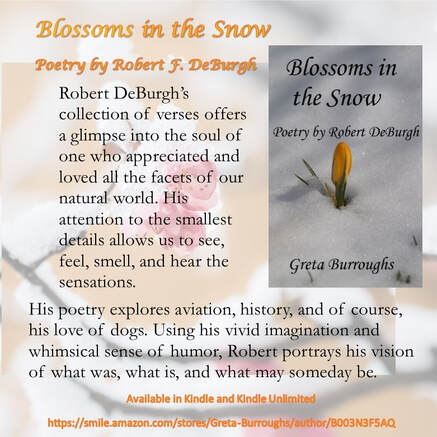
Robert's collection of verses in Blossoms in the Snow offers a glimpse into the mind of one who appreciated and loved all the facets of our natural world. His attention to the smallest details allows us to see, feel, smell, and hear the sensations he experienced, as well as the pleasure associated with them.  

His deep appreciation and fascination with nature come to life in his haiku. The simple three-line poems open up the deep-thinking side of the poet, who cherished all aspects of beauty in nature and life.

Spring is on its way. Warmer temperatures and longer days signal that it's almost time to witness nature's grand reawakening of the precious lives sharing this planet with us. Bare trees are starting to sport new leaves, nuts, and fruits. Barren fields are filling up with colorful, nectar-filled wildflowers.

Birds, insects, and other hungry creatures take advantage of warm days to venture from their winter homes to scout out the early blossoms. They appreciate the new life as much, if not more, than we do.
​
Robert loved springtime. He reveled in observing the transition firsthand and sharing the delight he experienced. From the cloud of gnats hovering overhead to the picnics shared with our loved ones to the lengthening daylight allowing us to spend more time outside, these simple joys are priceless. That's the gift Bob wants to impart to his readers through his haiku.
Read and enjoy!
SPRING'S REAWAKENING
Gnats in frenzied flight
Hover above fallow fields
Soon to feel the plow
***
Dappled morning light
Sunshine heats the noontime air
Cool and gentle eves
***
Sunny afternoon
A wicker picnic basket
On green river bank
***
Goldfish in a pool
Moving splashes of color
Among the lilies
***
People hurry by
On crowded city sidewalks
Taxis honk loudly
***
Night in the city
Neon signs brighten the dark
Traffic slows its pace


Picture


​Blossoms in the Snow
​

Kindle
 https://amzn.to/3C8Cfvz

Read for free on
Kindle Unlimited

0 Comments

Why Read????

2/28/2024

0 Comments

 
Picture
0 Comments

You'll Never Guess Where the Graham Cracker Came From

2/21/2024

0 Comments

 
Picture
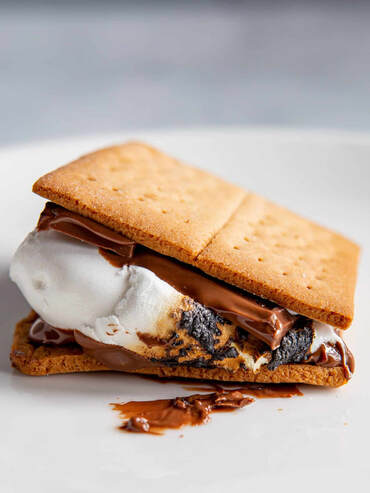
Imagine sitting around a campfire on a cool evening toasting marshmallows over the flickering flames. Your gaze never wanders as the glowing white glob hisses and spits.

The marshmallow emerges from the flame at just the right moment as a golden brown work of culinary perfection. As the melted, gooey confection oozes across the top of a Graham cracker, you grin in anticipation as you gently layer on some chocolate and another crunchy cracker. You look. You admire. You taste. Heavenly.

S'mores, what would life be without them? The chocolate and marshmallows are the main attraction tempting our taste buds… but don't forget the humble Graham crackers holding everything together. If it weren't for them, we'd just have a melted, sweet conglomeration with nowhere to go.

We must thank Sylvester Graham (1794-1851), a Presbyterian minister, for the ingenious combination of ingredients that now bear his name. Even though his original recipe for Graham cakes bears no resemblance to what we enjoy today, the story behind Graham crackers remains quite intriguing.

Rev. Graham was a staunch social reformer and an advocate for healthy living. He preached that too much lustful living harmed the body, and excessive sexual activity caused ailments ranging from headaches and indigestion to pulmonary problems, spinal diseases, epilepsy, and insanity. He also believed that offspring conceived in this manner would die early due to weakened stock.

Graham endorsed a strict high-fiber diet consisting of unrefined wheat flour, no fat, and no meats to suppress those carnal urges. In addition, Graham discouraged the use of mustard and ketchup since, according to him, it also caused insanity.

Surprisingly, Graham's doctrine was accepted by a limited number of people during the American health craze of the 1820s and 1830s. His converts gladly confined themselves to Graham boarding houses in New York and Boston, adhering to the strict regimen.

The Graham cakes made their grand entrance at that time. The Reverend wanted a special treat for his faithful friends and meticulously perfected his recipe made with unrefined wheat flour and without any sugar or flavorings. It became a staple among his followers to supplement the high-fiber vegetarian diet.

As with all fads, though, Sylvester Graham's healthy living philosophy fizzled out. Yet, the Graham cakes lived on – slightly modified, of course.

Graham's name remained because of the use of his highly proclaimed unsifted wheat flour. However, that was the only ingredient that survived the transition from Graham cakes to Graham crackers. It's a mystery who first concocted the cracker version, but the revised recipe appeared in a cookbook in 1882. The rest of the story is history.

The crunchy wafer we all know and love come from the National Biscuit Company, a.k.a. Nabisco. They began marketing Graham crackers in the late 1800s. But their record-breaking success came in 1925 when the company introduced the Honey Maid line, and the delicious treat has remained popular since then.

Sylvester Graham probably spins in his grave whenever his name is used to describe the cookie-like treat made with refined white flour and sugar. But hey, that's progress.
                                                        ~~~~~~~~~~~~~~~
You may be wondering what the history of Graham crackers has to do with books or writing.
Answer: Absolutely nothing. I just thought it was an interesting tidbit of history. At any rate, this is our Whatever blog, so it still fits, sort of.
                                                       ~~~~~~~~~~~~~~~~
Did you know…
I'm sure you know that S'more is a contraction of the phrase "some more." However, did you know the first recipe appeared in a Campfire Marshmallows cookbook in the early 1920s? The guide may have heralded the Graham Cracker Sandwich as an ingenious invention, but it was already a well-known treat for Boy and Girl Scouts alike.

The first official recipe for a s'more came out in the 1927 Girl Scout guidebook, "Tramping and Trailing with the Girl Scouts." While the book was intended to offer advice on being a good Girl Scout (always get a parent's permission before hiking!), its lasting legacy was the Some More.

The renamed recipe, credited to a troop leader named Loretta Scott Crew, calls for 16 graham crackers, eight bars of plain chocolate, and 16 marshmallows. The instructions say, "Toast the marshmallows to a 'crispy, gooey state.' Put the marshmallow on top of a chocolate bar, between two graham crackers, and voilà, you got a " Some More."

It's unclear when the name was shortened to simply s'more, but various Girl Scout publications referred to the treat as Some More until at least 1971.

Thanks, Dannye, for digging up these little-known facts! Now, I'm craving some gooey, toasted marshmallows, chocolate, and graham crackers.
​
How long has it been since you ate a s'more?

0 Comments

Valentine’s Day Wasn’t Always Romance, Flowers, and Candy

2/14/2024

0 Comments

 
Picture
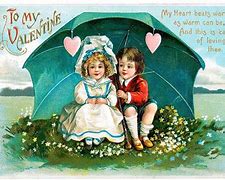
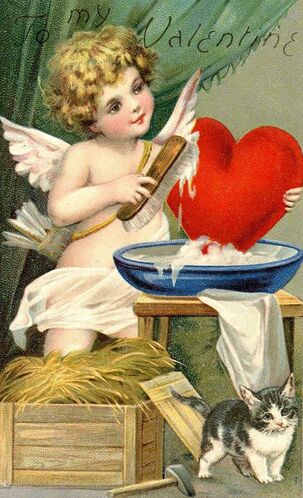
Today is St. Valentine’s Day. It’s the perfect occasion to express your heartfelt feelings to the ones you love.

It didn’t begin that way, though. On the contrary, the legend started out with intrigue, beheadings, and scattered body parts. To top that off, no one even knows who the real St. Valentine was. All the details have been lost to time, only to be transformed by the poets in tales of love and romance.

The story behind this February 14th celebration would make an excellent mystery novel. There are so many unknowns! First, the investigator must determine which of the 40+ St. Valentines died on that particular date. The next step entails lots of research to establish the causes of death – was it natural, or was the guy bumped off?
​
After weeding the list down to the Valentines killed on February 14th, the detective must use his little gray cells to piece together how an event featuring a martyred saint could become a symbol of romance and love—a challenging task.


Picture
Who was the Real St. Valentine?
The facts he uncovers lead our sleuth to believe the victim could be one of several people or a combination of several of them.

Two Valentines stand out as likely candidates, but neither dealt with matters of romance. Both were martyrs and were beheaded by Roman Emperor Claudius on the 14th of February, but in different years.

The first Valentine refused to renounce his faith and was placed under house arrest. The whole house converted to Christianity after witnessing the priest restore sight to a young blind girl. Once word reached the Emperor, Valentine was executed.

The second candidate, Bishop Valentine of Terni, was also known for his healing ability. The legend claims that a Roman scholar asked the bishop to heal his crippled son. After performing this miracle, the scholar, his family, and visiting friends converted to Christianity. Soon after, the bishop was arrested and killed.

A third Valentine could also be a contender. This priest defied Emperor Claudius by performing marriages for young lovers in secret. Claudius believed that single men made better soldiers than those with wives and families, so he outlawed marriage for young men. When these illegal marriages were discovered, Valentine was put to death.

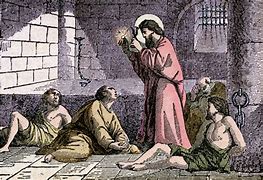
But that’s not all. Another Valentine helped Christians escape harsh Roman prisons. After being imprisoned himself, he supposedly sent the first “From Your Valentine” greeting to a young girl who visited him during his confinement.

Picture
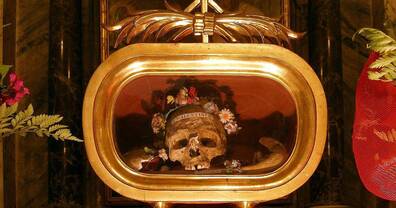
The facts behind the Valentine legends are murky. It’s going to be difficult, if not impossible, to track down the truth. Even more questionable is the validity of the saint’s sacred body parts believed to exist in churches across Europe. Our investigator must visit these places of worship in Prague, Rome, Madrid, Terni, Glasgow, and Dublin to search for any clues pertinent to his investigation.

Picture
The Romance Angle
Our gumshoe spends his time aboard his private jet, wracking his brain over where the romance angle comes in. Face it, Catholic priests and bishops do not mix all that well with images of Cupid. There is no evidence that any of these saints performed acts promoting romance, except that guy who wrote love letters from his jail cell to a kid. That doesn’t sound very likely and places Valentine number four at the bottom of the list of suspects.

So, what inspired Valentine’s Day? Google predicts it could have been the execution of Valentine, a pagan holiday, or Middle Age poets looking for new ideas to entertain their readers.
Our private eye has ruled out the executions of the assorted Valentines since there are no historical references to any parties where love-themed cards were exchanged for at least 1300 years or so after Claudius’ reign.

The earliest possible origin of Valentine’s Day evolved from the pagan holiday Lupercalia. Occurring in mid-February, it was popular and one of the few pagan holidays allowed to be celebrated after Christianity was legalized in the Roman Empire.

Lupercalia celebrated fertility. Men stripped naked and sacrificed a goat and dog. Young boys would then take strips of hide from the sacrificed animals and use them to whip young women to promote fertility.

We are getting closer to solving the mystery.

Anyway, all the wild parties came to an end when Pope Gelasius came to power in the late fifth century and put an end to the fun. To replace Lupercalia, the Catholic church declared February 14 as a feast day to celebrate the martyred St. Valentine. Unfortunately, the early Valentine’s Day celebrations substituted the fertility, love, and sacrifices with food and prayers honoring the saint. No romance.

The more modern notion of Valentine’s Day celebrating passion arose a thousand-plus years later when British author Geoffrey Chaucer introduced the idea of recognizing lovers during this annual feast. Evidence proves that much of the romanticized tales of St. Valentine originated from the imagination of Chaucer and other poets trying to liven up their work to attract more readers. (That is the opinion of our investigator, not historians.)

As far as Valentine’s cards go, they didn’t become popular until the 1400s. The oldest known Valentine still in existence today was a poem written in 1415 by Charles, Duke of Orleans, to his wife while imprisoned in the Tower of London.

That concludes the investigation. The mystery is solved. A priest or bishop named Valentine was martyred way back in the BC times. The Catholic church replaced the Roman pagan celebration, Lupercalia, with a calmer, more conservative feast in honor of St. Valentine. Chaucer added all the bells and whistles during the Middle Ages. The cards came into play a few years later. Case closed.
​
Any questions?


0 Comments

Inspiration Strikes at the Worst of Times

2/7/2024

2 Comments

 
Picture
   This is an article I wrote for Indies Unlimited. It was published on 03-22-2012.
 
For the last week, I have been sitting at my computer, wracking my brain, trying to finish a short story. After seven days of madly typing away, only four paragraphs appear on the screen in front of me. The countless hours working on this one story, and that is all I have to show for it? The right words elude me. I have deleted more material than I have saved. Where is my inspiration? Why won’t the words come to me? Have I lost my ability to write?

Desperation has set in. All I can think about is the stupid story. I need a distraction, maybe some housework. No, too close to the computer. How about yard work? Nope, I still look at my office window, and the siren song from my laptop lures me back inside.

Ah ha, an escape. I have a doctor’s appointment. I hate going to the doctor’s office, but the nervousness and dread offer something new to occupy my battered mind - a couple of hours away from the pull of my computer, just what I need.

While sitting in the waiting room at the doctor’s office, inspiration strikes. The words I have been desperately searching for come to me. That’s it, that’s perfect, but I don’t have access to my computer, not even a tape recorder or notepad. I’ve got to get these thoughts down before I lose them. Why now? Why here?

The other folks sitting next to me are staring; did I say something out loud? I don’t care what they think. I have to write this down before I forget it.

I run up to the receptionist and blurt out, “I need paper and a pen…oh, and can I borrow your clipboard?” I don’t want to say too much, or the words in my head might escape from my one-track mind. I nervously pace back and forth, muttering to myself while I wait.

Finally, after years…er minutes of waiting, she calmly hands over the requested materials to my shaking hands. Somehow, I made it back to my seat, still muttering to myself while scribbling down the words that had been repeating over and over in my brain.

All eyes are upon me. Have I grown a second head or something? Hasn’t anyone else ever had a flash of inspiration before, or are the giggles accompanying my writing too much for everyone to bear?

I hear voices coming from the office; two men carrying an oversized white jacket approach me. Distractions, not now. Can’t these people understand I am having an epiphany, a moment of sheer genius?

“I’m not crazy, I’m an author…just a few more sentences …” are my last words before being taken to a padded cell. At least they let me keep my notes. Now, how do I get a computer in here?


2 Comments

My Fictional BFFs

1/31/2024

2 Comments

 
Picture
Have you ever encountered a fictional character who instantly felt like a friend — someone who shares the same sense of humor, similar interests, and would have your back if the two of you wound up in a sticky situation?
 
My new Best Friend Forever comes across as a real person, not an imaginary person born from an author's imagination. Her experiences, feelings, and emotions make me laugh, cry, or cringe in fear as she peers around the corner to discover 'whodunit.'

For me, it's as if I'm not just reading a story. Instead, I'm actively participating in the action alongside my friend. Lately, cozy mysteries are my go-to evening read, where I imagine myself tagging along, pointing clues out to my companion. Even when the story ends, it's difficult to stop thinking about the book and being a part of the tale. I want to spend more time with my BFF.

A couple of weeks ago, as I was packing up my collection of paperbacks, I ran across Anne McCaffery's Dragonriders of Pern series. I was introduced to these stories over 30 years ago, but I still remember how much I loved them from page one. I recall several novels that captured my imagination, but nothing like the Pern books. They totally immersed me into McCaffery's fantasy world and didn't let go.

As I progressed through the series, I imagined being a Dragonrider and living in one of the weyrs. My best friend was my dragon. We fought thread together. We explored unchartered territory together. We were a team.

Of course, I interacted with F'lar, Lessa, Robinton, and all the other primary characters. Masterharper Robinton was my favorite human character and BFF. Everyone loved and respected him, and through McCaffery's outstanding descriptive writing, I got to know him and imagined being a part of his inner circle.

In my mind's eye, I rode with the Dragonriders who uncovered the long-forgotten original settlement. I witnessed the reawakening of AVAIS, the computerized artificial intelligence that had been buried beneath the deserted colony's sands for many years. I sat side by side with Robinton and the other leaders as AVAIS recounted the history of the early days on Pern. What an adventure!

Since then, I've 'befriended' other fictional BFFs, such as Doretta in Robert DeBurgh's Riders of the Wind. While Robinton and other literary personalities were friends, Doretta spoke to me in a way no fictional character has ever done before or since.

Quick note: I may be biased since my husband wrote this aviation-based historical fiction.

The tale revolves around his relatives engaged in this new and exciting profession. Over the years, Robert shared tales with me of his Uncle Charlie flying the newly charted mail routes and smuggling bootleg booze from Canada during Prohibition. Bob was proud of his mother, who earned a private pilot certificate when females were thought incapable of flying, and his father, an ace mechanic, devised ingenious ways to keep the planes in the air.

So, as I read each chapter and learned more about his family, it was easy to place myself in the cockpit alongside Aunt Doretta as she and Charlie explored flight routes over the jungles of the Pantanal and started their own airline. In the second book, Winds of Fate, Doretta fought against discrimination and sabotage as she delivered bombers and fighter planes to military bases across the US.

Robert confessed that he combined some of my characteristics with memories of his Aunt Doretta. That's probably why I felt such a kinship with her. She and I could have been incredibly close friends. I loved getting to know her and still regret never meeting this remarkable lady in person.
​
How about you? Have you ever encountered a fictional character who instantly became a friend? Tell us about your imaginary BFF in the blog's comments. Don't be shy. We won't divulge your secrets.

2 Comments
<<Previous
Forward>>

    Categories

    All
    Books
    Genre Articles
    Guest Authors
    Holidays
    Inspiring Children
    Memes
    Scribblers
    Writing

    Book Genres

    Picture
    Mysteries
    Picture
    Children
    Picture
    Thrillers
    Picture
    Fantasy
    Picture
    Women's Fiction
    Picture
    Science Fiction
    Picture
    Poems, Essays, etc.
    Picture
    Spiritual Psychology
    Picture
    Well-being


    Archives

    July 2024
    June 2024
    May 2024
    April 2024
    March 2024
    February 2024
    January 2024
    November 2023
    October 2023
    September 2023
    August 2023
    July 2023
    June 2023
    May 2023
    April 2023
    March 2023
    February 2023
    January 2023
    December 2022
    November 2022
    October 2022
    September 2022
    August 2022
    July 2022
    June 2022
    May 2022
    April 2022
    March 2022
    February 2022

    RSS Feed

I will read forever because it lets me visit in my mind the worlds that I will never be able to see; it helps me put away the stresses of the day and relax into the rhythm of the story before me; it lets me bring to the surface and experience without regrets those feelings I hide away; it lets me re-experience the thrill of first love through someone else's eyes; it keeps my mind juiced so that it will never desert me; it is always there for me even when there's no one else. I will read forever no matter whether it is print or digital because the words will always call to me. ~ A Sassy Scribbler